Thursday, 5 August 2010

Week 3 - Dion Hitchens

Select at least 2 of the following terms & discuss in relation to Hitchens' practice:
- Interaction
- Collaboration
- Site
- Cultural/History
- Technology

Hitchens is interested in Art as a continuum, and the participating in the process of drawing on previous art movements to create contemporary pieces, which will in turn be drawn on by future artists. A particular movement of importance to Hitchens in the post-modernist movement, as this was the first time art was not dominated by white, middle class males, and themes of feminism (and I use the word feminism as a general term to implicate the empowerment of minority/repressed societies) emerged, creating windows for previously repressed artists of non Western backgrounds to produce work. Hitchens' culture is an integral element of his practice. He draws strongly on his Maori background to create pieces with poignant statements about society, history and culture.

History is referenced both in the history of his materials and the history of the locations in which his work is situated. For example, he has utilised in one of his works a log from a tree which floated down the river as a result of the Mount Tarawera eruption. The history of this material is an integral element of the work, and reflects the importance in Maori belief of tangata whenua, and ideas of iwi having a direct relationship to the land. He uses physical documentation of an integral element of the history of the whenua of NZ - the wood even had a burnt smell. Hitchens states Richard Long as one of his influences. A similar theme is evident in Long's work. With reference to the image below, Long has stated that the mud he uses is tidal - its history is that it was created by the moon interacting with the stones over centuries. This encourages the viewer to consider the life of the material prior to its positioning in the gallery, and the significance of this. He has also exhibited work whilst expressly pointing out that he arrived at the location empty handed, thus using local materials, although this is perhaps less in direct relation to culture than in the work of Hitchens.


Throwing Muddy Water, Richard Long, 1967

His culture is reflected in his use of materiality & site within the work. Many of his works directly reference the space they are situated in. This could be in situating work in the window of an art gallery, not quite inside but not outside, and considering 'the space between'. This references the atea of the marae, the place between the physical world and the spiritual.

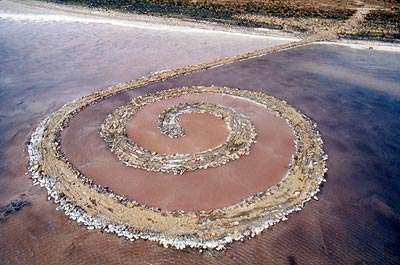
Another of his pieces which directly combines elements of site, history and culture is his current project, situated in Resolution Drive, Hamilton. This references the HMS Resolution, a ship used by Cook on his voyages around the Pacific. Acknowledging this place name as a reference to the colonial history of the site, Hitchens uses his symbolism to map out stories & represent the Maori history of the land - he creates a new piece of art to keep old stories alive. This work can only exist at this site. He quotes Robert Smithson as a strong influence - he also uses local materials & creates works which are site specific.

Spiral Jetty by Robert Smithson, 1970

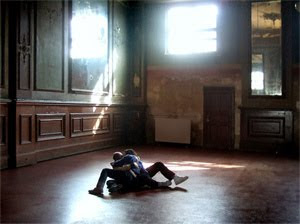
Interaction within his work again comments on culture, in his use of materials. A viewer might not expect a sculpture made from local land gathered materials to move, as technology is often assumed a part of Western as opposed to Maori design. Hitchens challenges this dated idea by surprising the viewer. He imposes interaction with his use of space within a gallery - the viewer must either walk directly through his work or make an effort to move around it. The eerie experience he creates reminded me of The Room with a Bird by Bundith Phunsombatlert, another work which forces direct interaction on the viewer and creates an unusual experience.


http://www.telegraph.co.uk/culture/art/3666254/Mud-mud-glorious-mud.html
http://en.wikipedia.org/wiki/HMS_Resolution_(Cook)
http://www.listener.co.nz/issue/3648/artsbooks/15244/riding_the_lead_balloon.html

http://www.portlandart.net/archives/smithson_spiraljetty.jpg

Tuesday, 27 July 2010

Week 2 - Rebecca Ann Hobbs

- Discuss 'the absurd' with regard to the exhibition 'Failing, Flying, Falling' by Rebecca Ann Hobbs.
- Who should be the winner of The Walters Prize 2010 and why? Summarise in one sentence.

I was immediately drawn to Hobbs' work by the colour schemes, compositions, humour and unusual moments portrayed. My immediate reaction to this work was respect and appreciation for the precise moments of time she captures. This is a theme she considers with relation to humour in her work - when is the punchline? Is it knowing something is about to happen, the moment it happens, or the moment immediately after? This exhibition demonstrates the subjects mid action, rolling, falling, spewing.. & causes you to wonder, what happens before & after? She is also interested in the relationship between the subjects and the viewer, highlighting this by capturing almost awkward and comical self portraits and including the cord for the remote shutter. Peter Shand has commented "the absurd is a condition that's present neither in us alone nor in the world as it stands but in the misregistration that results from the fact of that presence together." Hobbs considers this theory in the cafefully captured, precise moments she portrays and demonstrates within this exhibition.

The work which spoke to me most about the concept of the absurd is the video installation Tumbleweeds, 2004. Hobbs has taken the stereotype of tumbleweeds rolling across a Western movie style landscape and replaced the tumbleweeds with people. This is direct reference to her time spent at the California Institute of the Arts, where two of her assignments were to watch a Western movie each day (she hated Westerns), and to study the landscape which surrounded her. Tumbleweeds have obvious stereotypical connotations of boredom and lack happenings and she pokes fun at the absurdity of the situation she is in, also mocking Western films. As I watched the film and waited for the next 'tumbleweeds' to appear, the absurdity struck me of the viewer staring at nothing happening, and it seemed as though I was the willing subject and participant of a private but open joke.


Tumbleweeds, 2004, 3 min single channel video

Tumbleweeds reminded me of a work by Tino Sehgal which a friend of mine performed in during the Auckland Triennial this year. This work involved employing dancers to constantly roll for hours in a row in a very specific pattern & time frame, taking over from each other to cover the entire chronological length of the exhibition. Upon further research, it seems he is interested in making art which rejects materiality, and his works involve performance art which only lasts the length of the exhibition, studying the relationship between the viewer and the exhibit within the art gallery. This theme runs parallel with Hobbs' interest in the interaction between the viewer and the work. Whereas in Hobbs' work, the absurdity & punchline are obvious to the viewer & shared with the artist, Sehgal seems to be an experiment of a private agenda & leave the viewer & performer to interprete at will. I remember one of the dancers confiding in me that she had no idea what his work was about, and sometimes she would experiment with rolling slightly differently to the precisely prescribed pattern, to test if he was watching somewhere, & see what would happen. Sehgal did not even visit Auckland during that time (he is based in Europe & anti air flight) and the dancers merely followed a set of very specific instructions. The absurdity here is evident - did the artist even have any idea how his installation was progressing? It seems to me that the absurdity of this is a poignant element of his work and that perhaps the performers were part of the experiment as much as the viewer. Other works of his include a couple kissing. He creates awkward moments of confusion and questions the way the viewer looks at the artwork, forcing them to realise their participation. Hobbs also highlights his moment, but rather more empathetically, and via a photographic medium. Sehgal's works exist only as constructed situations between the performer and the viewer. Hobbs invites the viewer to enjoy the absurdity of the joke in an up front fashion, whereas Sehgal leaves the viewer wondering.


Installation by Tino Sehgal


This doesn't tie in with any comment I would like to make about the absurd, but Jump, 2009, distinctly reminded me of Henri Cartier-Bresson's famous photograph Behind the Gare St Lazare, and seems to pay homage to this work. That the subject is fully clothed lends itself to the theme of absurdity, as this act captured by Hobbs serves no evident purpose. Peter Shand comments in his essay that "Bas Jan Ader riding his bicycle into an Amsterdam canal, for example, is the sort of bathetic slapstick that both amuses and draws attention to a shared existential condition. The activity is essentially meaningless or at least it serves no singly declared purpose." This could be applied also to Jump. Why is the subject jumping fully clothed into the water? Why is he alone on a raft in the middle of the water? The viewer is left wondering.


L-r: Behind the Gare St Lazare, Henri Cartier-Bresson, 1932. Jump, Rebecca Ann Hobbs, 2009

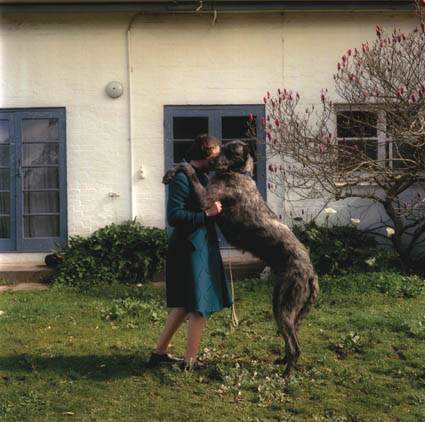
Hobbs' works also reminded me somewhat of works by photographer Diane Arbus. Each photographer approaches their general subject matter from a different angle. However, both capture that moment which leaves the viewer to wonder, and play on society's conventions. Arbus, in this image below, captures an otherwise happy child in an exasperated moment, clutching a toy hand grenade. Here is an example of a darkly humous, absurd image. Arbus famously photographed freaks and the viewer is invited to consider the story behind this image, whilst at the same time enjoy the face value of the comedy it provides. The image I have included from the series Suck Roar by Hobbs also captures an absurd moment, poking fun at the concept of beastiality and playing with implications, confronting the viewer.


& finally... Dan Arps should be the winner of The Walter Prize 2010 because all the other finalists are awful.

Source material for this blog entry:

- http://www.realtimearts.net/article/52/69086908
- Discussions with performance artists
- http://www.aut.ac.nz/study-at-aut/study-areas/art-design/learning-environment/st-paul-street-gallery/exhibition-2010/previous-exhibitions2/march---april/The-4th-Auckland-Triennials/art-design/learning-environment/st-paul-street-gallery/exhibition-2010/previous-exhibitions2/march---april/The-4th-Auckland-Triennial
- http://re-pubblica.blog.kataweb.it/2008/03/04/constructed-situations-tino-sehgal-magasin-3-stockholm-konsthall/
I'm Walking Backwards for Christmas, essay by Peter Shand

Revelations, Diane Arbus, 2003

Articulate, June/July/August 2010, St Paul St Galleries, AUT University

http://www.realtimearts.net/data/images/art/23/2303_hobbs.jpg

http://en.wikipedia.org/wiki/Child_with_Toy_Hand_Grenade_in_Central_Park

2003-2006 Diane Arbus: Revelations. Victoria and Albert Museum, London

Tuesday, 20 July 2010

Week 1: Mary Curtis

Explore the relationship between function and decoration in the works of Mary Curtis, with relation to her process and the presentation in the exhibition 'Metadecorative'.

Mary Curtis has quoted about past works that "This [new body of] work challenges the way we relate to objects of utility by changing them into objects of decoration." Mary Curtis, 2004. This comment also holds true for her exhibition, Metadecorative, which is currently on display at Objectspace.

Mary Curtis utilises objects with existing functions to explore the relationship between functional and decorative elements, and jewellery as an object for display as an artwork. Earlier works by Curtis have featured such materials as steel nuts and a used wire cage from a champagne bottle. She is interested in the transition between utility and decoration. When does an everyday object become a decoration? Perhaps this is merely in the perception. This is corroborated with her comment "To look at a thing is different to seeing a thing." This highlights the difference between looking at an object at its face value, such as a wire cage to ensure the containment of the champagne, and seeing it for what else it could be, such as a pendant. What is the real difference between this item and a pendant specifically designed for display? When does one become the other?
Pendant, sterling silver, mild steel nut, cord (2004)

The works features in Metadecorative seem to take these questions even further. Curtis has pushed forward her ideas by using materials which are traditionally decorative for their own purpose and transformed them into jewellery. Wallpaper is heavily featured in her works, usually a decoration for the wall, but now for the body and display as part of an artwork. Curtis has removed the original everyday decorative function and created a different decorative function. She has achieved this by merely altering the context of the material. The fragility of the material used in her process emphasises this transition in function. It would force the wearer to take greater care to maintain its original condition. She considers the idea of adorning ourselves whilst simultaneously impairing our everyday actions, and taking this to the extreme in the materials used.
Black Brooch With Green Oval (2008-2010)
Pink And Orange Necklace (2008-2010)

Grant Thompson has commented that this theme is related to the chosen title of the exhibition - Metadecorative. He states that it "points to her work as decoration about decoration, as decoration that investigates the intricacies of decoration's histories, languages and forms to produce new forms of decoration." 'Meta' is a prefix used in English to indicate a concept which is an abstraction from another concept, used to complete or add to the latter. Curtis is drawing on extensive research on decoration to push forward further concepts of exploring this theme. Her process draws on meticulous research, exploration & experience, reflecting strongly museum and gallery visits during her time in Europe. Constantly collecting materials, photographing her work table every day & keeping everything she makes ensures development and further abstraction of her decorative works, tying in neatly with the exhibition theme.

The presentation of Curtis's works highlights the relationship she draws between function & decoration. Traditionally, jewellery is displayed on stands as I have pictured, the front on display but the back concealed, as it would be against the body. Curtis reveals the work in its entirety, exposing and celebrating all angles as important elements of the work. She displays them in vitrines, providing each piece with its own space, highlighting its independent value as a work of art, also reflecting the roots of the inspiration for the creations - the history of decorative adornments. The jewellery pieces she displays in Metadecorative are presented as independent works of art, each in its own space, available for examination by the viewer from any angle. They are all round decorations for display purpose within the context of an artwork, not created merely to be work on the body. The boundaries of the traditional decorative function of jewellery are blurred in this way. Displaying the objects at eye level enabled me to scrutinize them closely and added to the sense of preciousness and value, despite the use of non precious materials in monetary value.

Considering the work of Helen Britton, a strong influence on Curtis, gives us an insight into her process of collecting materials & how this is connected to her themes of function & decoration. Britton has commented, of her own work, that "My practice is accumulative, experimental and heterogeneous, faithful to my life experience. It is also a conscious dialogue with matter, form and ideas." There are obvious similarities here with Curtis' process in the themes of collection, transformation and abstraction from original purpose of an object. There are visual similarities within the work of both artists in that they both respect the jewellery they create as aesthetic from all angles. The artists share an appreciation of a subdued colour palette and the concept of many objects working together to 'bounce off' each other and create a new dynamics, creating different compositions of decoration. This broach by Britton successfully exemplifies this & demonstrates a strong influence on the work of Curtis in Metadecorative.
Green structure, 2006, Helen Britton. Brooch, silver, paint, glass.